
2026 Korea inbound tourism report · EP. 03
Hospitality insightsHotels and shared accommodation: where do international guests stay, and for how long?
At a glance
Most surveyed visitors used hotels, while Seoul shared-accommodation users reported an average 8.5-day stay. Prepare practical living guidance for guests staying several nights.


At a glance
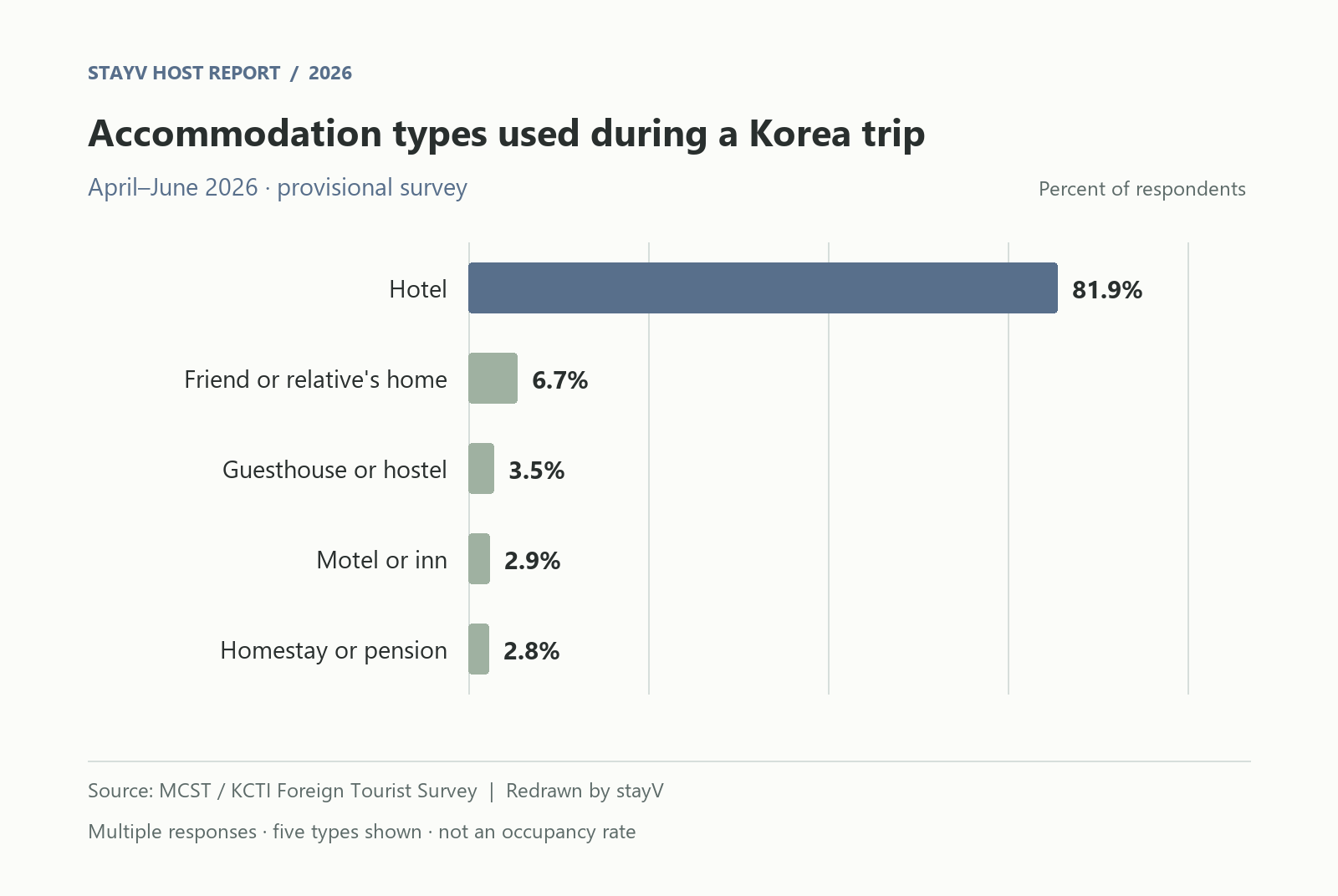
- Hotels led accommodation-use responses at 81.9% in the national second-quarter 2026 survey.
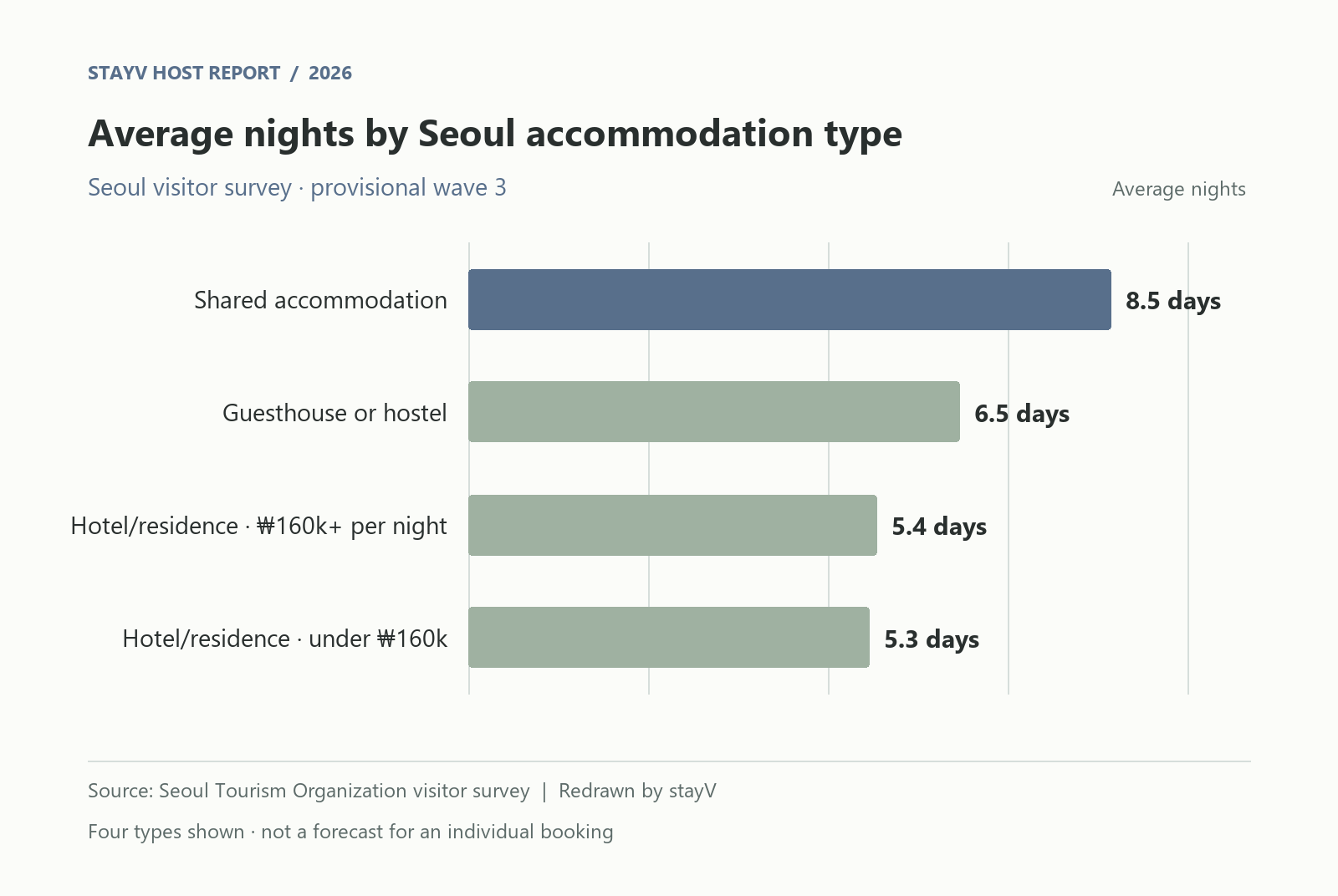
- Seoul shared-accommodation use was 11.5%, with an average reported stay of 8.5 days.
- These usage responses are not room-occupancy rates.
- Clearly explain your service scope, including interim cleaning and extra towels.
- Prepare laundry, rubbish and heating guidance for multi-night guests.
Learn more
Start with the stay your property can offer
A photogenic room and a practical place for several days overlap, but are not identical. Bedding and atmosphere stand out on arrival. Later, guests need somewhere to dry clothes, open luggage and eat. The guests you want to welcome affect which facilities to assess.
Read the survey question before interpreting accommodation figures. Reported facility use, sold rooms and total trip duration measure different things. Here we use travellers’ reported accommodation use and average accommodation stay lengths.
View graph figures in a table
| Category | Value |
|---|---|
| Hotels | 81.9% |
| Friends/relatives' houses | 6.7% |
| Guesthouses/hostels | 3.5% |
| Motels/inns | 2.9% |
| B&Bs/pensions | 2.8% |
What widespread hotel use asks of small properties
The provisional second-quarter 2026 national survey recorded hotels 81.9%, friends’/relatives’ homes 6.7%, guesthouses/hostels 3.5%, motels/inns 2.9% and homestays/pensions 2.8%. These are the top five multiple-response categories, not shares of all rooms. National visitor survey
Describe what you provide rather than broadly claiming to be better than a hotel: a dining table, space for a group or a location suited to neighbourhood life. Clear service boundaries help align expectations without trying to provide every hotel service.
Explain whether interim cleaning is included, how guests obtain extra towels and how to report a problem. Photos alone rarely convey these operating arrangements. Waiting until after arrival can reveal mismatched expectations too late.
Seoul’s 8.5-day figure is a reason to review living guidance
In Seoul Tourism Organization’s third-round June 2026 provisional survey, reported use was hotels/residences below KRW 160,000 per night 39.1%, at or above that price 33.9%, guesthouses/hostels 15.3% and shared accommodation 11.5%. Shared accommodation is the survey category illustrated with Airbnb and Wehome; it does not exactly match the administrative foreign-tourist urban homestay category.
The same table reported average stays of 8.5 days for shared accommodation, 6.5 days for guesthouses/hostels and 5.3/5.4 days for the two hotel/residence price bands. This suggests reviewing information needed for everyday living. It does not show that a type of accommodation causes longer stays or predict your future bookings.
View graph figures in a table
| Category | Value |
|---|---|
| Shared accommodation | 8.5 days |
| Guesthouses/hostels | 6.5 days |
| Hotel/residence 160,000 won or more per night | 5.4 days |
| Hotel/residence less than 160,000 won per night | 5.3 days |
You need not immediately change minimum stays. Review your own booking history, cancellation conditions, cleaning availability and supplies for longer visits first. The average offers a prompt for checking guidance, not a universal rule.
Anticipate questions during a multi-night stay
Washing-machine guidance goes beyond Start. Guests need detergent placement, drying options and any late-night restrictions. Rubbish guidance needs sorting rules, a location and permitted times together.
| Situation | Information to prepare |
|---|---|
| Doing laundry | Detergent, basic cycle, drying and permitted times |
| Needing more towels | Provided quantity, replacement and request method |
| Ordering food delivery | Collection location and packaging/food-waste disposal |
| Feeling cold at night | Heating controls and signs of normal operation |
| Accumulating rubbish | Sorting, disposal location and times |
| A property problem | Contact method and host response availability |
Combine short sentences with actual facility photos. Start with the most common operation rather than every button. Update guidance when facilities or supply locations change.
Prospective hosts should test everyday movement
Look beyond bed counts. Can doors open with suitcases spread out? Can several people get ready together? Does drying laundry block a passage? A spacious room may still be inconvenient without storage.
Check the host’s work too: cleaning-tool and linen storage, rubbish handling and access for appliance inspections. Consider both guest comfort and sustainable maintenance.
Organise living instructions by facility in stayV
Use stay information and amenity cards for washing machines, heating/cooling and kitchen equipment. Add short text to actual photos, and use rules or FAQs for service arrangements such as towels and interim cleaning. Check text and photos together in the guest view before publishing.
Operating hosts can start with one recurring multi-night question. Prospective hosts can consider how to explain a facility while choosing it. Writing the instructions may reveal missing supplies or unclear operating decisions.
Explore stayV Host · Write amenity instructions · Organise rules and FAQs
Data basis and sources
National figures use the provisional second-quarter 2026 International Visitor Survey's accommodation-use table, PDF page 53. Seoul figures use accommodation and average stay lengths in the third-round June provisional survey, report pages 33–34. Usage responses differ from room occupancy and administrative registration shares. Average accommodation stays are not generalised to entire trips or every reservation. stayV redrew charts from official figures.